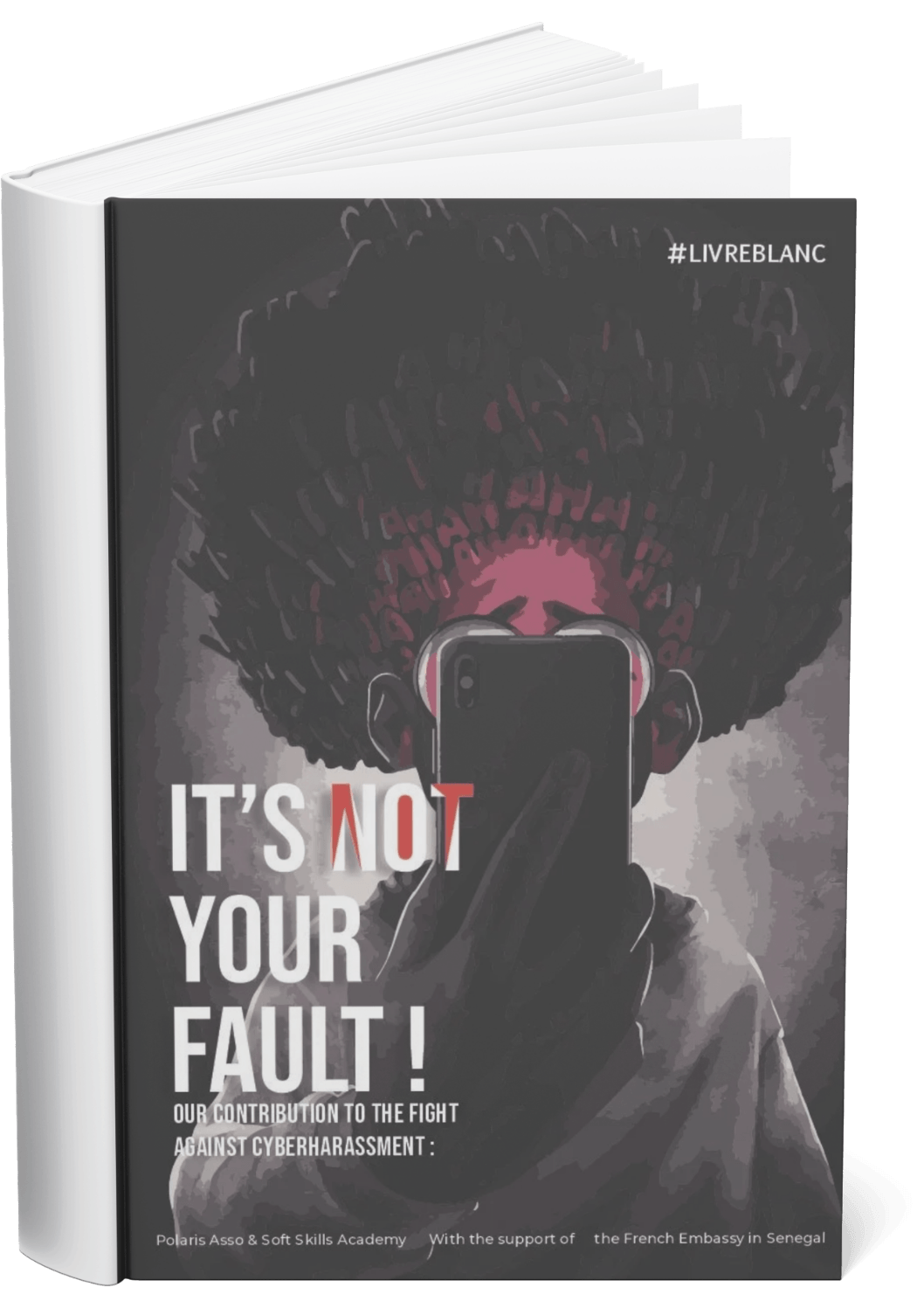
In Senegal, the country’s 8 million internet users spend an average of 6 hours and 49 minutes per day in a digital space that remains insufficiently secure, particularly for the youngest users. Cyberbullying represents a massive, complex and structurally under-documented phenomenon: while 73% of respondents in this project consider its consequences to be as serious as those of physical harassment, one in two victims still does not know how to protect themselves or report incidents.
This white paper, produced by Polaris Asso and the Soft Skills Academy of Groupe ISM with the support of the French Embassy in Senegal, draws on a survey of 424 individuals in the commune of Yoff, two focus groups held in October 2022, and 21 expert consultations — spanning public institutions, international organizations, education professionals, legal practitioners and mental health specialists. It stands as one of the rare empirical publications produced by Senegalese civil society on this subject.
The document exposes an alarming reality: the absence of any first-level listening and support platform, largely unknown reporting mechanisms, awareness campaigns concentrated in Dakar and conducted exclusively in French, and media coverage that treats cyberbullying as a news item rather than a civic and pedagogical concern. Women and young girls are by far the primary victims — confirmed by 85% of respondents — further silenced by sociocultural pressure that transforms shame into secrecy.
For Polaris Asso, breaking this silence is a founding act. The full set of recommendations addressed to the State, parliamentarians, media outlets, digital platforms and families deserves to be read and embraced by anyone convinced that protecting young people online is a non-negotiable condition of democracy.